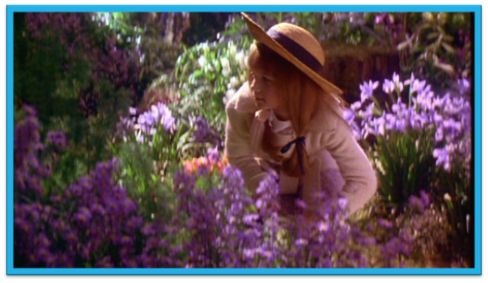
In my teenage years, I must have read this book a thousand times. The first time, when I was around 9 years old. Back then, I truly admired the writer’s capability of transporting the reader into another realm, a fantasy world of flowers and adventures. For one second, I would think I really was inside the Secret Garden myself.
This publication is essentially written for children. To be more precise, it falls under the category of juvenile literature. This genre is adored by pre-adolescents also known as school-age children, children from 7 to 12 years old, (Erikson, 1970 & Appleyard, 1991). In this stage, children essentially learn from external influences that teach them how to behave within set cultural and societal norms. For example, at school and from friends or books. In a similar manner, the book includes external influences that convey moral standards. To illustrate, the garden inspired Mary and Colin, the two main characters of the book, to become a better version of themselves. Furthermore, as a result of their personal change, the flowers in the garden start to bloom. In this example, the writer communicates that if you do well in life; you care about others and you behave politely, you will be rewarded. Thus, the book is suitable for a pre-adolescent audience since daily life situations are mirrored and therefore recognizable to the target group.
Moreover, the personal journey in which the protagonist Mary becomes more independent through self-exploration can be seen as typical pre-adolescent behavior. According to Appleyard (1991C) and Erikson (1970), the journey of becoming more independent and developing personal feelings is an archetype of pre-adolescent behavior and moreover, is related to the increased ability to organize and relate information. To illustrate: “give her simple, healthy food. Let her run wild in the garden. Don’t look after her too much. She needs liberty and fresh air and romping about” (Burnet, 2017, p. 76). Looking back at the previous statement, this example demonstrates how the book includes parental roles that encourage children to develop self-regulation in order to become more independent. Thus, because of Mary’s journey of self-exploration, she becomes relatable to the target group.
Another reason this book is suitable for pre-adolescents is because it contains a fairly elementary structure. Children like to read books with “repetition of the plot while constantly changing the setting” (Appleyard, 1991, p.5). To begin with, the novel includes repetition. To illustrate, in the story, Mary repeatedly visits the Garden, a place where new people and life are discovered. In addition, the characters are also quite simple. According to Appleyard, in juvenile literature, “characters are mostly ‘simple’ and use stereotypes to build the character. You can usually sum up the character in 3 characteristics” (Appleyard, 1991, p.16). The main characters Mary and Collin are presented in a similar way. To illustrate, according to the outcomes of the class discussion, Mary and Colin both are spoiled, self-centered, and unfriendly.
Furthermore, this novel is packed with symbolism. To illustrate, at the beginning of the story, Mary was removed from her toxic environment and had to start all over again. She goes on a trip to discover a new area which symbolizes her change and personal growth. To illustrate, at the beginning of chapter 10, the narrator explains that Marry feels like she doesn’t want to sleep anymore.
“She had no intention of going to sleep, and, in fact, she was becoming wider awake every day which passed at Misselthwaite. She was beginning to like to be out of doors; she no longer hated the wind, but enjoyed it. She could run faster, and longer, and she could skip up to a hundred. The bulbs in the secret garden must have been much astonished. Such nice clear places were made round them that they had all the breathing space they wanted, and really, if Mistress Mary had known it, they began to cheer up under the dark earth and work tremendously. The sun could get at them and warm them, and when the rain came down, it could reach them at once, so they began to feel very much alive” (Burnet, 2017, p. 57).
In this case, not wanting to sleep doesn’t refer to physical sleep but more like a mental sleep. Since Mary’s growing appreciation for the difficulties that life brings, she no longer hates the outdoors. Looking at the context, the outdoors could also be a symbol for the unknown world or something out of your control.
During class, we discussed how this book belongs to the category juvenile adventure. Although, it isn’t a conventional “fairytale, animal fable, mystery nor mythic fantasy” (Appleyard, 1991, p.3) book, it is a good representation of juvenile literature because of its simple historically realistic storyline, uncomplicated characters, self-exploration and repetition. Moreover, the story is told from a third-person omniscient point of view. Which according to Wiehardt (2019), helps the reader to identify with the narrator since information about the feelings and thoughts of all characters are provided. Even though, at first, Mary’s character isn’t very appealing, after her change it is hard not to appreciate her perseverance. To conclude, The Secret Garden is an uplifting book about how personal growth can inspire others, and that, on their turn, can become a greater version of themselves as well.
Bibliography
Appleyard, J. A. (1991). Becoming a reader: the experience of fiction from childhood to adulthood. Cambridge: Cambridge Univ. Press.
Erikson, E.H. (1970). Reflections on the dissent of contemporary youth. International Journal of Psychoanalysis, 51, 11-22.
Kijk-goed (n.d.). The Secret Garden [image]. Retrieved on March 4, 2020, from https://kijk-goed.eyefilm.nl/films/the-secret-garden
Van der Wal & De Wilde (2017). Identiteitsontwikkeling en leerlingbegeleiding. Bussum: Coutinho
 Literature II: Youth Literature