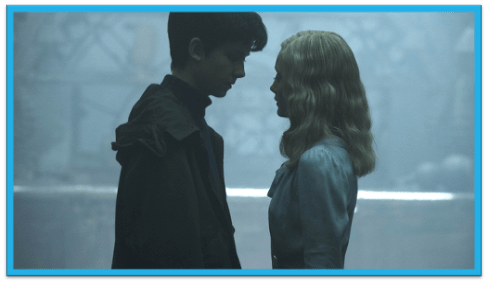
For this week’s blog, I read Miss Peregrine’s Home for Peculiar Children. Although this is a popular novel, the public might only recognize the title because of the film adaptation, which was directed by Tim Burton. Not that it matters, but in my opinion, the book outshines the movie. Therefore, I will elaborate on how this book includes the search for identity and age suitability, followed by the class discussion in which I describe the characters and setting of the book.
The theme of the week is the search for identity. A development that the protagonist undergoes is archetypical for adolescents and, therefore, relatable to the target audience. To develop his identity, like other adolescents, Jacob explores his independence and develops a sense of self, (Erikson, 1970). The principal character Jacob Portman, a typical 16-year-old American teenager from Englewood lives, according to his own words, a pretty boring life. During the week he goes to school, hangs out with his friend Ricky and works in his family’s store. After a plot shift, Jacob’s character changes. The protagonist feels lost, confused and depressed. He feels like an outsider, a person who doesn’t belong in Englewood. According to Erikson’s psychosocial development theory, these characteristics are part of human development and occur in the adolescent phase (12-18 years old). Erikson shows that when becoming older, people “transition from childhood to adulthood, they may have felt confused or insecure about themselves and how they fit into society” (Erikson, 1970. p. 4). They call this an identity crisis. “According to Erikson, an identity crisis is a time of intensive analysis and exploration of different ways of looking at oneself” (Hogeschool Utrecht, n.d., p. 2). And that is exactly what Jacob is going through. Throughout the story, Jacob is constantly searching for his identity. Moreover, he feels like adults don’t understand him. To illustrate, when the narrator talks about his 16th birthday party, which normally is a big deal to an American teenager.
“I could not have been less in the mood for a party. (..) I’d begged them to skip the party this year because, among other reasons, I couldn’t think of a single person I wanted to invite, but they worried that I spent too much time alone, clinging to the notion that socializing was therapeutic” (Riggs, 2016, p. 56).
This example demonstrates typical behavioral traits of adolescents such as rebellion, isolation, and mood swings, (Appleyard, 1991). Which suits the target audience since adolescents prefer reading about characters who are real to life, characters that face similar problems in life and therefore are relatable, (Appleyard, 1991). Given that most adolescents face similar problems at a later stage, to have a better understanding of the book, I would recommend this book to adolescents aged from 14 to 18 years old.
In addition, the book is appealing to 14- to 18-year-old individuals because it combines their favorite genres. According to Appleyard (1991), girls like to read romantic stories and boys read adventure, science-fiction, war, and sports stories. Riggs included multiple elements such as science fiction, romance, adventure, and war. In the following example, Jacob reflects on his life as a time-traveler.
“Stars, too, were time travelers. How many of those ancient points of light were the last echoes of suns now dead? How many had been born, but their light had not yet come this far? If all the suns but ours collapsed tonight, how many lifetimes would it take us to realize that we were alone? I had always known the sky was full of mysteries but not until now had I realized how full of them the earth was” (Riggs, 2016, p. 342).
This example demonstrates that science fiction and adventure are included in the book. Therefore, the book is indeed very suitable for this target group.
Like other young adult literature, the book includes the literary genre of tragedy. In their search for truth and information, adolescents learn to understand how the real-world works. Therefore, this genre “suits the adolescent’s realization that the real world is not the green world of romance but a much darker and more dangerous place” (Appleyard, 1991, p.15). During class, we discussed how Jacob had to choose between two worlds. First, the orphanage, a safe and peaceful place where his friends lived. Or the actual world, a world that is described as dark and evil, a place with bad memories. Throughout the book, the protagonist struggles with this decision. Until the end, when he realizes that he much rather wanted to escape this world and life, he lives in the peaceful loop. Therefore, we concluded Jacob belongs in the loop since he also has a superpower and if he did not have a special gift, he would could never enter the world.
At last, while looking back on the story. I discovered a whole new theory about what could actually have happened to Jacob. Although his grandfather had recently passed away, he plays a fundamental role in Jacob’s life. To illustrate:
“Growing up, Grandpa Portman was the most fascinating person I knew. He had lived in an orphanage, fought in wars, crossed oceans by steamship and deserts on horseback, performed in circuses, knew everything about guns and self-defense and surviving in the wilderness, and spoke at least three languages that weren’t English” (Riggs, 2016, p. 12).
Seemingly, Jacob idolizes his grandfather. According to Jacob is his grandfather like a father to him. Although his father is still alive, he doesn’t feel like they are connecting on the same level. They do not share mutual interests. But the story gets more interesting after Jacob’s father reveals that grandpa’s stories weren’t exactly real. To illustrate:
“Compared to the horrors of mainland Europe, the children’s home that had taken in my grandfather must’ve seemed like a paradise, and so in his stories it had become one: a safe haven of endless summers and guardian angels and magical children, who couldn’t really fly or turn invisible or lift boulders, of course. The peculiarity for which they’d been hunted was simply their Jewishness. They were orphans of war, washed up on that little island in a tide of blood” (Riggs, 2016, p. 21).
This example could be foreshadowing what is going to happen to Jacob. In the beginning of the book Jacob discovers his grandfather, dead, on the ground. After finding his dead grandfather, he seems like a changed person. He is in shock and is sent to a doctor. Which makes me think that this is just a story about Jacob going insane and becoming like his grandfather. What do you think?
To conclude, in an age of confusion, this book shows how everyone can be perfect in their own way. And, that when you feel like an outsider you should embrace your weirdness. And that is, in my opinion, a welcome message when you are a struggling teenager.
Bibliography
Appleyard, J. A. (1991). Becoming a reader: the experience of fiction from childhood to adulthood. Cambridge: Cambridge Univ. Press.
Erikson, E.H. (1970). Reflections on the dissent of contemporary youth. International Journal of Psychoanalysis, 51, 11-22.
Google (n.d.). Miss Peregrine’s Home for Peculiar Children [image]. Retrieved on March 2, 2020, from https://www.google.com/search?q=Miss+Peregrine%27s+Home+for+Peculiar+Children&tbm=isch&ved=2ahUKEwjOhdqnp7PoAhWFNOwKHawIDu0Q2-cCegQIABAA&oq=Miss+Peregrine%27s+Home+for+Peculiar+Children&gs_l=img.3..35i39j0j0i67l8.73395.73395..74042…0.0..0.73.73.1……0….1..gws-wiz-img.23GDTwtw1l8&ei=Ohd6Xs6AN4XpsAeskbjoDg&bih=679&biw=1432#imgrc=0q78PtTMp0BcHM&imgdii=HTkJEGENIONUxM
Riggs, R. (2016). Miss Peregrine’s Home for Peculiar Children. Philadelphia, USA: Quirk Books.
 Literature II: Youth Literature